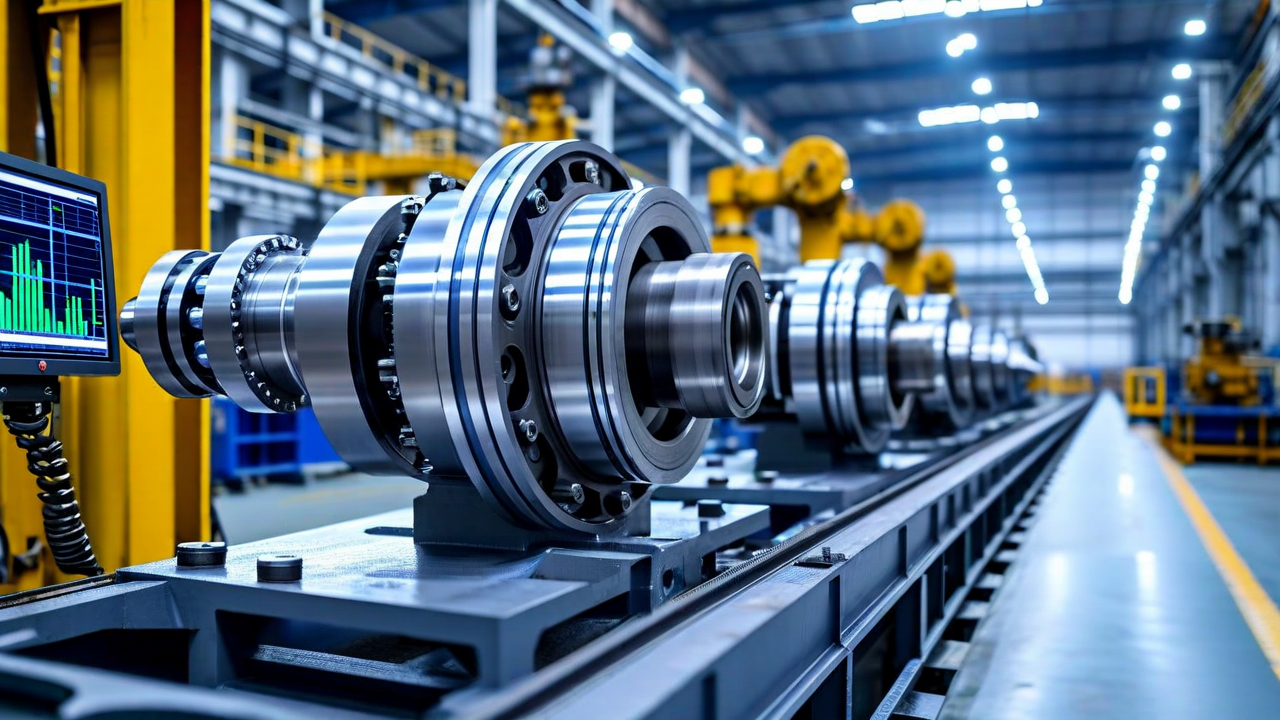
In the fall of 2025, a flat-rolled steel producer in the Great Lakes region was running a 4-strand hot strip mill at full capacity. They had 38 vibration monitoring sensors installed on their main drive train — pinion stand bearings, backup roll chocks, and the work roll bending cylinder assemblies on Strands 2 and 3, which had the worst historical failure record.
On October 9th, the monitoring system flagged a rising outer race defect frequency on the drive-side pinion bearing of Stand 4. The initial alert was a Stage 1 warning — bearing defect frequency visible in the spectrum at 3.4x the expected amplitude but still within the operational threshold. The maintenance supervisor was notified and scheduled a physical inspection for the following shift change.
The Signal Escalated Fast
The physical inspection confirmed the vibration reading — elevated temperature at the bearing housing, slight discoloration of the grease purged during inspection, and a faint but audible high-frequency tone through the inspection port. The bearing was an FAG 23260-B-K-MB spherical roller bearing, 300mm bore, the main thrust bearing for the Stand 4 pinion shaft. Replacement lead time from the regional distributor: 9 days.
By October 11th, the system had escalated to Stage 2. The defect frequency harmonics had multiplied and overall vibration had risen from 0.31 in/s RMS to 0.58 in/s RMS over 48 hours. The rate of change — not just the absolute value — was the critical signal. The alert model flagged the escalation rate as consistent with inner race spalling, a failure mode that typically progresses to functional failure within 3–6 days of Stage 2 detection.
The Decision and the Logistics
The plant maintenance manager faced a choice: run to failure and risk a catastrophic bearing collapse in the middle of a production campaign, or pull the strand offline for a planned bearing replacement. Based on the monitoring data, the team decided to shut down Stand 4 on the night shift of October 12th — approximately 72 hours after the initial alert.
The bearing had been emergency-ordered on October 10th when the escalation rate first became apparent. An FAG factory-direct emergency order, air freighted from their Schweinfurt distribution center, arrived on October 12th at 3:00 PM — eight hours before the planned shutdown. The replacement team had the bearing housings pre-staged, the crane booked, and the alignment tools on site before the shift ended.
Total planned downtime for Stand 4: 19 hours. The bearing was replaced, the shaft was realigned to 0.001" TIR, and the strand was back in production on October 13th at 11:00 PM.
What a Failure Would Have Cost
The maintenance team ran the numbers on the alternative scenario — run to failure. Based on their previous experience with a Strand 2 pinion bearing collapse in 2022, a catastrophic bearing failure on a hot strip mill pinion stand typically results in:
Shaft damage requiring either machining or shaft replacement. Contamination of adjacent bearings and gearbox housing from spalled material. Potential damage to pinion gear teeth if the bearing seizes and the shaft deflects under load. Cleanup and inspection of the entire strand before restart. The 2022 failure took 11 days to repair and cost the facility $2.3 million in lost production, emergency parts, secondary equipment damage, and labor. The strand runs approximately 210,000 tons of hot band per month at a conversion margin of roughly $110/ton.
The Comparison
The planned replacement on October 12th cost $28,400 all-in: the FAG bearing ($8,200 at emergency pricing), air freight and logistics ($3,100), crane and technician time for the 19-hour job ($12,600), and production loss during the planned outage ($4,500 in margin terms for 19 hours on one of four strands). That 19-hour window was taken during the plant's lowest-demand production window — overnight on a Tuesday — and the other three strands continued running throughout.
Avoided cost: $2.3 million. Investment in the monitoring system that caught it: $74,000 for hardware and installation across the 38 sensors, plus $21,600 in annual licensing. That's $95,600 total system cost. One avoided failure event returned the full investment 24 times over.
What Made the Difference
The maintenance supervisor noted afterward that the most critical factor wasn't the detection — it was the lead time. "Seventy-two hours sounds short, but it was enough to order the bearing, get it here from overseas, stage the job, and time the outage for when it hurt us the least. If we'd found out at 24 hours, we would have been scrambling with a stock bearing that wasn't quite the right fit and doing the job on emergency time. At 72 hours, we did it right."
The escalation rate model was also important. A single-point threshold — "alert when vibration exceeds X" — might have triggered too late or too early. The rate-of-change analysis, which flags when a signal is rising faster than a baseline degradation curve, gave the team actionable information about how fast the situation was developing, not just where it was at that moment.
What They Changed After
Following this event, the plant expanded monitoring to cover all four strands' pinion stand bearings and the top backup roll chocks, which had been on their planned expansion list but hadn't been prioritized. They also implemented a tiered response protocol: Stage 1 alert triggers inspection scheduling, Stage 2 alert triggers part ordering and shutdown planning, Stage 3 alert triggers immediate production rate reduction and accelerated shutdown.
In the 16 months since deployment, they've caught three additional bearing events before failure. None resulted in unplanned downtime. The total cost of those three planned interventions: $91,000. Estimated avoided losses based on the 2022 failure benchmark: $6.9 million.
Running hot strip mill or heavy rolling equipment?
We've instrumented pinion stands, backup roll chocks, and drive train bearings at multiple rolling mills. Talk to our team about what a deployment looks like at your facility.
Contact Our Team